.svg)

Uber Who?: Navigating the Unpaid Family Ride-Share
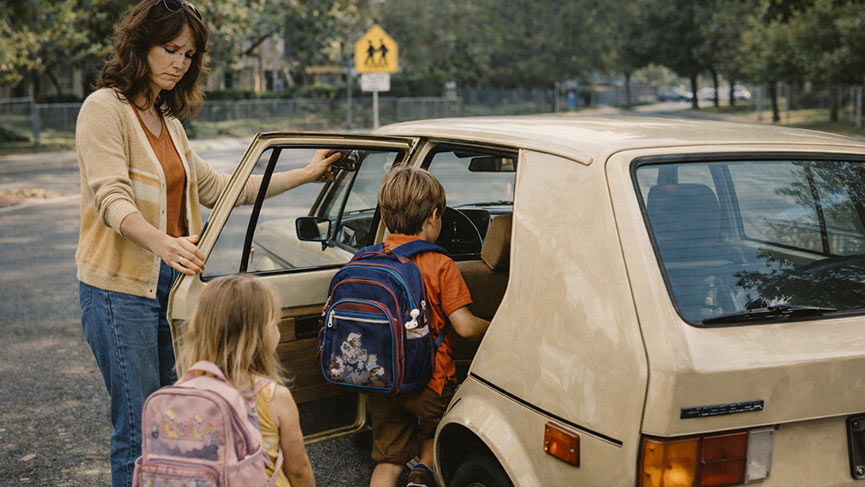
On becoming the unpaid chaffeur for kids, parents, and pets.
Editor’s Note
My car is half vehicle, half science experiment. On any given day you will find a rouge fry or a tangled hair tie.
My siblings and I may disagree in some areas, but we are fully aligned on dental exam parking strategies.

Welcome to Unpaid Transit: The Caregiving Commute
Spending more time in your car than in your own bed is a Sandwich Generation rite of passage.
That you’ll know every drive-thru worker by name and exactly which parking spot at the medical plaza gets you closest to the elevator.
We’re not just caregivers and parents. We’re full-time drivers without the tip jar, the benefits, or the ability to decline a ride request.
And while everyone talks about emotional labor and time scarcity, almost no one talks about a silent leak in our bank accounts: the literal cost of being everyone’s wheel.
The Miles (and Dollars) Add Up Faster Than You Think
Here’s a stat that’ll make you pull over:
Many family caregivers spend hours every week driving to medical appointments, pharmacy runs, and errands for aging parents, often on top of school drop-offs and kid activities.
The National Aging and Disability Transportation Center (NADTC) found that caregivers spend about five hours per week either providing transportation or arranging it for older adults.
The financial breakdown:
- Gas (obviously, painfully, constantly)
- Vehicle wear and tear (including that mystery rattle that won’t quit, even when you blast No Scrubs to ignore it)
- Parking fees at hospitals, clinics, and sports fields
- Insurance hikes from all that mileage
- Drive-thru meals inhaled between destinations
- Pet boarding during all-day medical marathons
- “How is this $19.99?” emergency gas-station phone chargers
According to AARP, family caregivers spend an average of $7,200 per year out of pocket. Transportation is one of the biggest hidden line items; paid now, sorted out never.
Caregivers frequently pay transportation costs without seeking reimbursement, either because it’s overwhelming or they don’t realize it’s possible.
Translation: we’re subsidizing care with our money and our sanity, and too tired to track either.
Caregiving starts in the driver’s seat
Transportation caregiving doesn’t look the same for everyone, but it hits everyone.
Some days it’s leaving work early to get a loved one to an appointment, answering messages from the waiting room, and trying to understand medical terms no one explained clearly.
Other days it’s juggling group texts, schedules, and responsibilities across generations. The car becomes the only place where all the moving parts briefly meet.
Most people also know the moment of explaining (again) why you need to step out, while quietly doing the math about whether paying for one ride would make the day work.
Caregiving research also shows how common this responsibility is: about 78% of caregivers help with transportation or errands.
Because everything else requires getting there first.
Sandwich Generation Ubers gotta have balls (joints)
A ball joint is small, underappreciated, and carries a ridiculous amount of responsibility.
If it gives out, everything wobbles… and then falls off.
So yes.
We feel seen.
The School Run Spiral: When “Just Drop Them Off” Becomes a Second Job
Remember when you thought the school bus would handle this?
LOL.
Driver shortages, route cancellations, and consolidated stops mean more parents are now driving daily. Add after-school activities and staggered dismissal times, and you’re spending hours in carpool lines while calls start without you.
Parents report that school commutes are actively impacting work schedules, mental health, and family budgets, especially in car-dependent school systems that assume every family has flexibility, fuel, and time.
And if your kid forgets something? You do the loop again, this time with resentment riding shotgun.
The Survey Moment: Let’s Get Real About Your Wheel Time
How many hours a week are you driving for caregiving?
Parents. Appointments. Prescriptions. School. Sports. Pets. Groceries. Emergencies.
Actually add it up.
Research suggests many caregivers log 15–20 hours a week in transportation alone — the equivalent of a part-time job that costs money instead of paying it.
What You Can Actually Do
(Because We’re Not Just Here to Depress You)
Need help turning this into something practical? We’ve put together a Caregiving Commute Cheat Sheet with prompts, checklists, and search terms you can use to find help in your area
Click here for your free download.
Laugh Line
The only thing getting a workout in my life is my car’s odometer and my bladder control.
Life Line
You’re not failing. You’re doing something genuinely hard, expensive, and undervalued.
The miles you drive are proof of love — not proof you’re doing it wrong.
If you need to ugly-cry in your car before the third pharmacy run of the day, do it. Your car has seen worse.
Glossary Schmossary
Words are hard. Midlife is harder.
Your decoder ring awaits:
Proof we are not making this up
- Transportation: What Caregivers Need to Know
- The Hidden Costs of Caregiving Day To Day By
- Family Caregivers Spend More Than $7,200 a Year on Out-of-Pocket Costs
- Caregiver Statistics: Demographics
- 2025 School Drop-Off and Pickup Report
Coffee hot. Tank half full. Still driving. You got this.
Spotlight