.svg)

The Invisible System: Managing Everything, All at Once
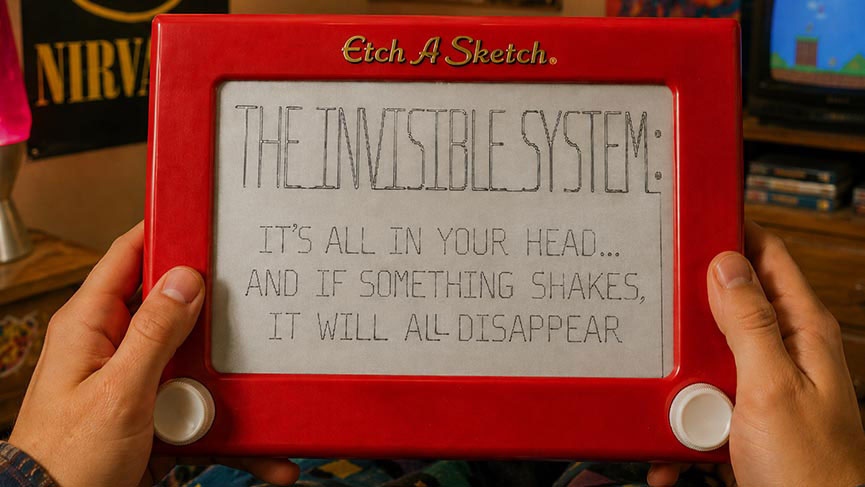
It’s all in your head… and one shake can make it feel like everything disappears.
Editor’s Note
There are days I feel less like a person and more like a walking Etch A Sketch. Every reminder, appointment, and backup plan is somehow stored in my brain, and if one thing throws me off, it suddenly feels like I’ve forgotten everything.
At this point, my brain has 47 tabs open. What was I talking about again?
If You Blink, You’ll Miss It The Work Nobody Sees
The Sandwich Generation isn’t just doing tasks, we’re carrying entire systems in our heads.
Appointments. Medications. Passwords. School forms. Grocery gaps. Family dynamics. Backup plans. Emotional buffering. Whoa.
It’s like living inside a giant Etch A Sketch, everything carefully held together, until one shake makes you feel like the whole thing might disappear. And most of it happens invisibly.
Nobody sees the calendar management. The contingency planning. The emotional buffering. The “if this happens, then we’ll do this” mental spreadsheets quietly run in the background 24/7. It’s not just caregiving anymore, it’s operational leadership with no off switch.
The Cognitive Load Is Real
The reason mental load feels so exhausting is because it often lives entirely in memory.
Researchers have found that caregiving and household management aren’t just physical responsibilities, they’re cognitive responsibilities.
Sociological research has found that women often carry the “cognitive labor” of family life; the invisible work of remembering, planning, organizing, and anticipating everyone’s needs, even when household chores themselves are shared.
Translation:
Someone has to mentally hold the entire Etch A Sketch steady.
GenSando calls it:
“Why am I the only person who knows the dog is out of food?”
Caregivers Second Full-Time Job and Decision Fatigue
According to AARP, family caregivers spend an average of 26 hours per week providing unpaid care. That’s on top of careers, parenting, relationships, and basic human survival. Which makes sense when your brain is functioning like the family’s operating system.
The Cleveland Clinic explains that constant decision-making reduces emotional regulation, patience, focus, and energy over time.
Which explains why, “Does anyone care where we eat?” can suddenly feel like an act of psychological warfare. Because it’s never actually about dinner. It’s about being the person mentally tracking everything all day long.

One Shake From a Blank Screen
The hardest part of mental load isn’t the tasks themselves.
It’s the fear of what happens if you stop holding everything together.
Because when systems live entirely in your head, one interruption can feel catastrophic:
A missed reminder, one sick day or bad night of sleep, and suddenly you’re staring at the mental equivalent of a blank screen wondering: “What did I forget?”
The GenSando Tool:
The “One System” Rule
If your brain feels like a browser with 86 tabs open, stop trying to perfectly organize your whole life overnight.
Pick ONE system this week.
Examples:
- Shared family calendar
- Medication list note
- Sunday planning check-in
- Shared password vault
- “Who owns what” caregiving list
The goal is not perfection, it’s reducing the number of things your brain has to individually carry.
Because not everything should have to live inside your head.
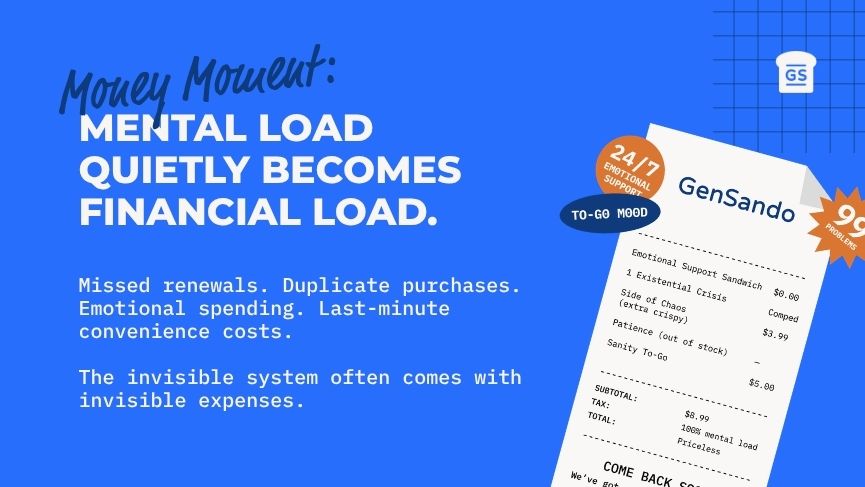
The Fine Print of Midlife
Sources & Research:
- AARP Caregiving Statistics
- Cleveland Clinic – Decision Fatigue
- American Sociological Review – Cognitive Labor Studies
Laugh Line
At this point, if my family asks where something is, I’m considering charging a subscription fee.
Life Line
If you feel exhausted even when you technically “didn’t do that much today,” there’s a good chance your brain did, and that counts, too.
The mental tabs don’t close because people depend on us. But we deserve support, too.
Spotlight