.svg)

The Group Chat CFO: When Family Decisions Cost You
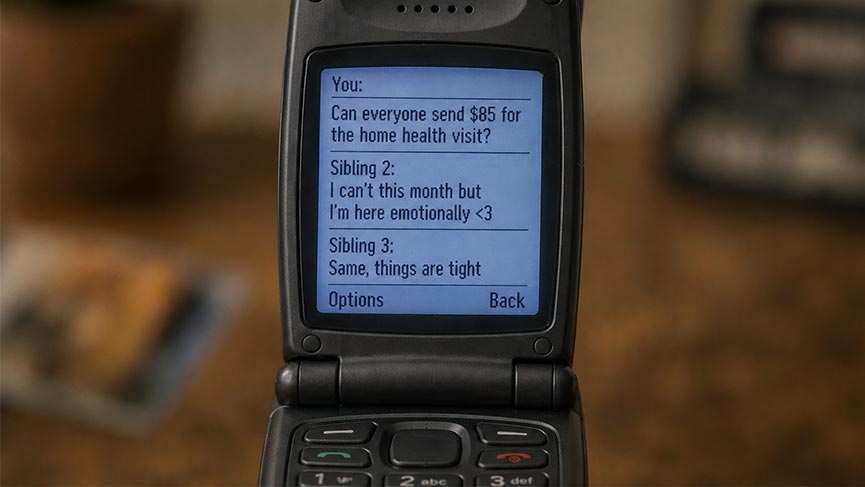
The texts, the tension, the tallying, then one person carries it.
Editor’s Note
Family dynamics with aging parents are already a lot, then add group texts where tone gets lost. My brother and I don’t always nail it, but we try to stay grounded in love. It’s a balance and words matter.
My siblings and I keep it respectful, even when it’s messy. But when a thread goes sideways, I’ve got a move: “Can’t find my readers, not seeing this clearly.” Not avoidance… I call it strategic delay.
“Whatever You Think Is Best”
In many families, caregiving begins with a shared understanding: everyone will pitch in, decisions will be made together, and responsibilities will be distributed as needed. On the surface, it feels collaborative. There are group texts, quick check-ins, and general agreement that “we’ll figure it out.” No one starts off thinking they will be the one to bail.
But caregiving doesn’t unfold in big, scheduled decisions. It happens in real time. A prescription, a follow-up appointment, another bill arrives. These moments don’t wait for consensus, and over time, the person who steps in first often becomes the person who keeps stepping in.
“Whatever you think is best” slowly shifts into centralized care. And without ever being formally assigned, one person becomes the operational and financial hub of the family.
What The Data Actually Says
Caregiving in the U.S. is both widespread and uneven.
According to AARP and the National Alliance for Caregiving, about 63 million Americans are providing unpaid care. On average, caregivers spend $7,200+ out of pocket each year, covering everything from prescriptions to transportation to home support.
And it’s not just money, it’s time. Many caregivers are balancing jobs, kids, and 20–40+ hours of care per week, creating real financial and emotional strain.
Efforts like the Credit for Caring Act aim to provide financial relief for caregivers, acknowledging the real costs families are already carrying. And through the Slice of Life Survey, we’re turning everyday experiences into data that can help drive that change faster.
Caregiving has been invisible for a long time. That’s starting to change, and this is how we make it count.
The Bigger Picture: The 2030 Problem
If this dynamic feels familiar, it’s not just about your family, it’s part of a much larger shift often referred to as the “2030 problem.” As millions of Baby Boomers move into their 70s and 80s, the demand for care is rising quickly, while the systems designed to support that care haven’t kept pace. The challenge isn’t just about cost, it’s about capacity.
Who is actually going to manage all of this? At the same time, the number of available family caregivers per older adult is shrinking, as families get smaller, live farther apart, and juggle more competing responsibilities. Which leaves a gap. And in many cases, that gap doesn’t get filled by a system, it gets filled by a person. Usually, the one who answered the text first. The group chat is the symptom of this widespread problem.
Group Chats we found on the internet
If caregiving had a paper trail, it would look a lot like these text messages.
Somewhere between “I got this one” and “I’ll Venmo you,” a pattern starts to form.
And yes… if any of these feel familiar, you’re not alone. We figured you needed a good laugh!
The “I’ll Venmo You” Mirage
You:
Hey, I covered Mom’s $312 prescription. Can everyone Venmo me their part?
Sibling 1:
Omg thank you 🙏 I’ll send later today!
Sibling 2:
You’re the best seriously
Sibling 3:
👍
(3 days later)
You:
Hey just bumping this!
Sibling 1:
Ahh sorry crazy week!! Will do tonight!
(narrator voice: they did not do it tonight)
The “Whatever You Think Is Best” Classic
You:
Doctor recommends we start in-home care, about $1,200/month. Thoughts?
Sibling 1:
Whatever you think is best
Sibling 2:
Yeah trust your judgment
Sibling 3:
You’re so good at this stuff
You:
Thank you?
The Spreadsheet Era (No One Opened It)
You:
Hey I made a Google Sheet to track expenses so we can split evenly!
Sibling 1:
Wow this is amazing
Sibling 2:
You’re so organized
Sibling 3:
👏👏👏
(Sheet views: 1 — you)
The Late Night Reality Check
You (11:42 PM):
Hey just paid the ER bill—$1,150. We can figure it out later.
Sibling 1 (next morning):
Omg thank you you’re incredible
Sibling 2:
Seriously we’d be lost without you
Sibling 3:
Let me know what I owe!
(you staring at your bank account like it just betrayed you)
The Part We Don’t Talk About Enough

Caregivers in this role are often balancing more than tasks, they’re balancing relationships. Wanting to help while also recognizing their own limits. Wanting to keep things peaceful while quietly carrying more than feels sustainable. Conversations about money, time, and responsibility can feel uncomfortable, especially when care is so closely tied to love. It’s easier to just handle it than to risk tension.
But this is also where small shifts can make a real difference.
Simple things like naming roles out loud, setting up a shared way to track expenses, or having a quick monthly check-in, can start to redistribute not just the work, but the weight of it. Even a sentence as small as, “Hey, can we figure out a way to split this moving forward?” can open the door to something more balanced.
When expectations are clearer, decisions feel less loaded. When communication is more direct, resentment has less room to build.
Glossary Schmossary
Need help figuring out what all these words mean? Care plans, ADLs, long-term care? It’s a lot.
Think of this as your caregiving equipment guide.
Laugh Line
The group chat said “we got this.”Your bank account would like a word.
Life Line
Stepping into the role of “the one who handles it” often happens quietly.
Recognizing it is the first step toward not having to carry it alone.
Seen. Delivered. Cited.
- https://www.aarp.org/pri/topics/ltss/family-caregiving/caregiving-in-the-us-2025/?utm_source=chatgpt.com
- https://www.aarp.org/caregiving/financial-legal/financial-impact-caregiving/?utm_source=chatgpt.com
- https://www.caregiving.org/new-report-reveals-crisis-point-for-americas-63-million-family-caregivers/?utm_source=chatgpt.com
- https://alzimpact.org/creditforcaring
We see you. We get you.
And we’re figuring this out right alongside you.
Spotlight






SUBSCRIBE TO
GenSando
Delivered weekly.